Don’t Press Start Yet
Making a good game takes great failures.
Publishing a commercially successful game takes even greater ones .
Today, I’ll try to cut through the BS, and talk about how you can have a better shot at creating a game that players obsess over. Especially if you’re new to this game, it’s important to understand core values that will make your game great, not just another download.
Let’s get started.

Reframe your mind.
The foundation of any successful game lies in understanding its core mechanics and how it fits with the target audience. Interestingly, these two will have more crossovers than you imagine. It’s not enough to simply have a cool concept; you need to deeply comprehend the underlying actions and rules that captivate players. Anything you’ll build upon will rely on these fundamentals.
Take the match-3 genre, for example; the simple yet addictive loop of matching colourful candies has sent the likes of Candy Crush to stratospheric heights. It gave them, and many other titles, a foundation to build the growth upon. Or consider the social deduction mechanics that have made Among Us a big hit, producing millions of sus players worldwide. These games expectedly have more complex engagement loops and side mechanics, but their core mechanics are what the game is built upon.
Equally crucial is defining your ideal player. Who are they, and what motivates them? What cycles of action, reward, and progression will keep them coming back, time and time again? Whether it’s the satisfying collect and upgrade loop in an idle game or the tricking friends in a social deduction game, understanding your players’ desires and behaviours is the first rule of crafting an engaging game.
Differentiate, sometimes partly.
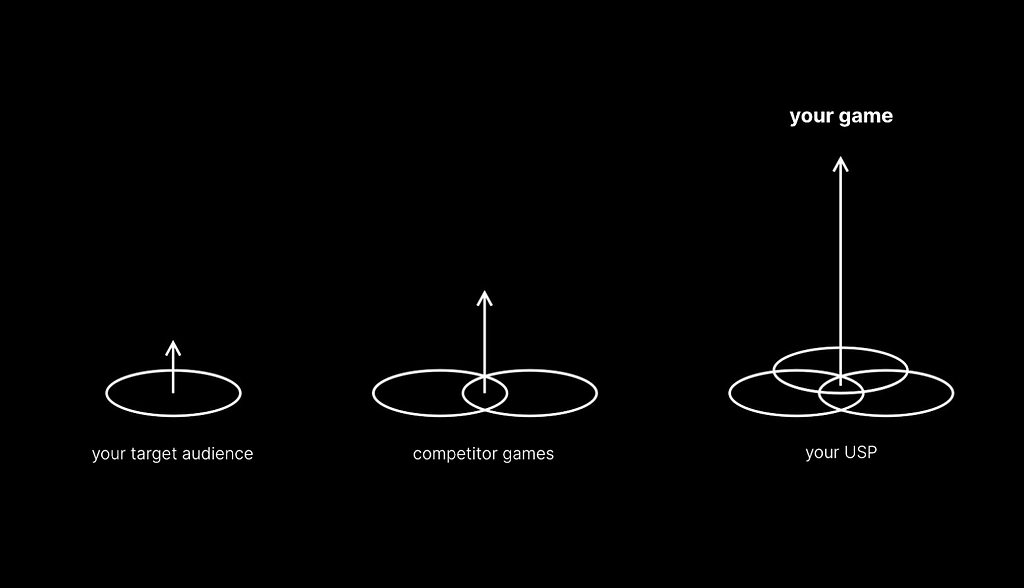
We have to acknowledge two things. First, the game industry is becoming more and more competitive, both on PC and mobile. Second, games are a hit driven business, and it’s difficult to thrive. This is why your USP (unique selling point) will always play an important part.
What sets your game apart, and why should players choose it over the myriad of other options available to them? Perhaps it’s an innovative art style that amplifies the game feel, or a fresh take on a familiar genre that subverts expectations. Whatever your USP may be, it’s crucial to identify and amplify it, ensuring that your game carves out a great experience in the hearts and minds of your audience.
I’m absolutely not saying that every game should be unique, in fact the other way around, you can always build upon strong foundations. A great example would be Vampire Survivors and Survivor.io. You can build a different -yet similar in essence- experience upon a core mechanic, and grow in a vertical that you target. You can try a different art style, different modes, merge it with another mechanic, try new monetisation models. The limit is your target audience’s expectations and patience.
Especially on F2P mobile titles; differentiation is only half the battle; to truly thrive, you must also consider the longevity of your creation (let’s forget about the reality of UA for now). If you aim for your game to have lasting appeal, and revenue, you must understand how live ops is truly done. How the hit games are not just a standalone title, but a continuously evolving experience that keeps players engaged…
Well, in casual mobile titles, we try to keep them stimulated.
This could take the form of seasonal content updates, competitive ladders, limited time challenges, or even expansions that breathe new life into the core experience.

Understand your finish line.
Bringing a game to life is a multifaceted process, and understanding the distinct phases of this lifecycle is essential for navigating the path to success. It all begins with prototyping, the creation of a rough yet functional version of your game to test ideas and validate assumptions early on. This is not about aesthetics, but rather solid core mechanics and ensuring that your target audience genuinely enjoys the core mechanic itself. Overall, this is what you should be obsessing over anyway. Remember: great games are built on top of great, solid, juicy core mechanics; that makes you “feel” it when you do something in the game.
Once you’ve defined your MVP and tested it with non-biased players, it’s time to iterate and refine. Fail fast, make changes, and retest without investing heavily in development, especially in the early stages. Staying agile allows you to validate your assumptions and ensure that your game truly resonates with your intended audience. Try not to fall in love with your game, and try to utilise public feedback as much as you can. Whether it’s subreddits or promoting your game on X, just try to get feedback organically. Extremely important thing to note:
The feedback you’ve been receiving from your SO, family, friends…
They are pointless.
Usually feedback received from the loved ones are quite polished. Even if they promise you to stay objective. Do not rely on this feedback, instead, utilise organic sources mentioned above.
Just to add: as you progress, it’s crucial to keep a close eye on your competitors. Relentlessly research and play their games, join their communities. Identify their strengths, weaknesses, and market strategies. Utilise tools to gain insights into their user acquisition tactics (e.g. Meta Ad Library), social media presence, and community feedback. Armed with this knowledge, you can carve out your exact target, refine your roadmap, and develop a GTM strategy that aligns seamlessly with your target audience.

Fail better.
The gaming industry is a dynamic, ever-evolving and crazy landscape, and success is never guaranteed. I love mentioning the successful games I’ve designed.
But the bigger story is I’ve built 40+ games that utterly failed before my first hit.
Even the most meticulously planned and executed projects can -and will- face unexpected challenges and setbacks. The key is to embrace this reality and make backup plans accordingly. Strategize your financials and monetisation models before they become necessary, and create a funding plan that accounts for potential pivots or opportunities.
Most importantly, remember that your game, or even your team, will likely face failure at some point. Plan for how you will pivot and monitor for new opportunities. Embrace the reality that nothing is certain in this industry, and be prepared to adapt and evolve with the changing tides.
As you Press Start, keep in mind that the path to success is paved with prototypes, iterations, and a relentless focus on your target audience. And lots of failures.
Understand their motivations, behaviours, and pain points. Ruthlessly analyse your competitors and utilise data-driven tools to gain insights. Craft a go-to-market strategy that aligns perfectly with your unique value proposition.
Above all, never lose sight of the reason you embarked on this path in the first place: the pure, unadulterated joy of creating a game that captivates and delights players.
It’s easy to get bogged down in the minutiae of metrics, monetisation, and market trends, but at the heart of it all, we’re in the business of crafting magical moments that transport people to new worlds, challenge their assumptions, and forge unforgettable memories.